From Everyone for Everyone
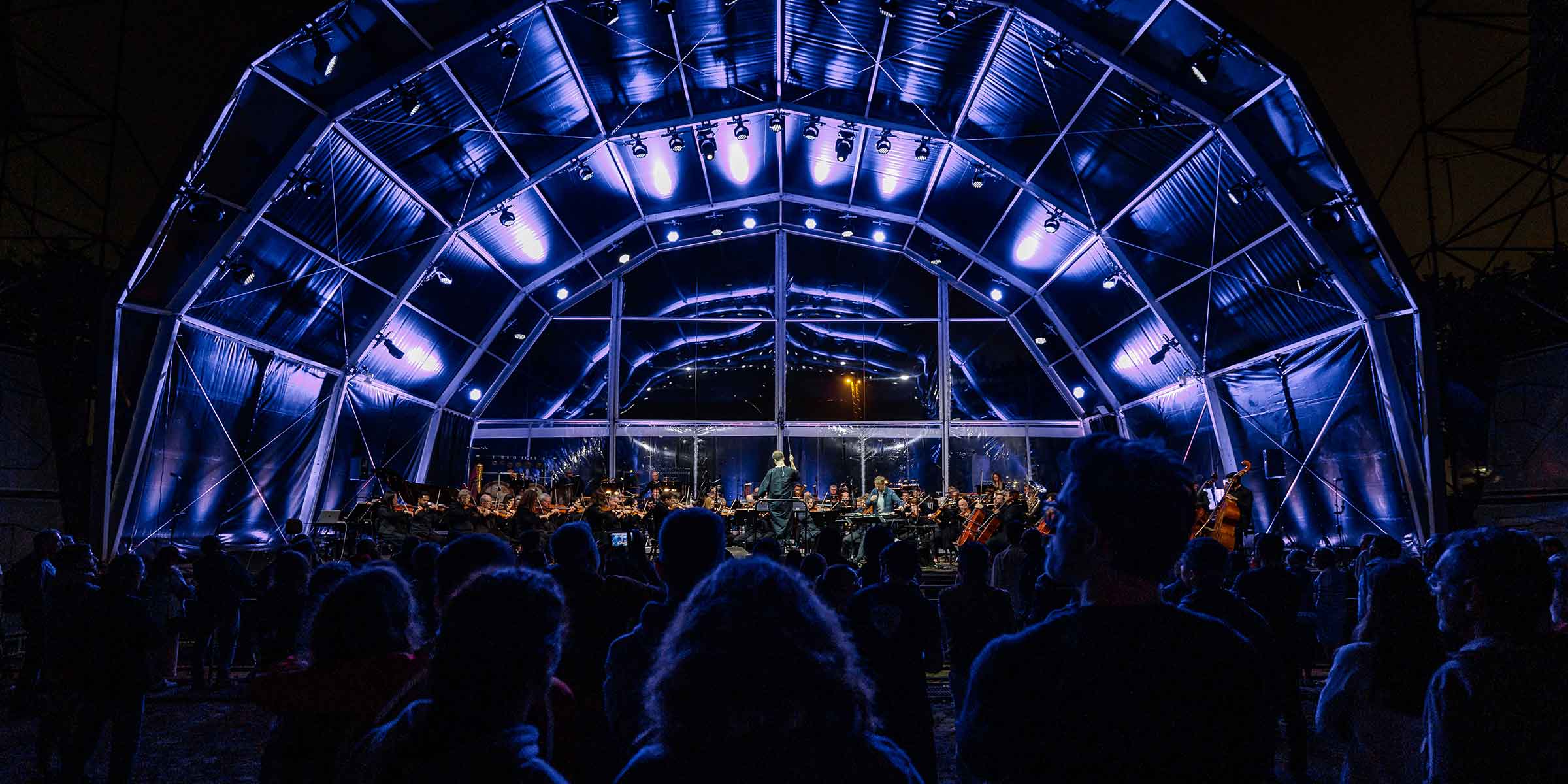
These are four open-air concerts held across different locations in the Porto Metropolitan Area, each offering a richly diverse repertoire that departs from the traditional expectations of a symphonic ensemble. This summer, the musicians of Orquestra Sinfónica do Porto Casa da Música take to the streets once again for a series of evenings where musical styles and inspirations intermingle freely.
There will be fado and jazz, 19th-century compositions, and orchestral renditions of Brazilian popular music – an exceptional opportunity to hear and feel the versatility of instruments typically devoted to classical music.
The first concert takes place on July 12 in Vila Nova de Gaia, featuring renowned fado singer Cristina Branco, who joins our Symphony Orchestra to show that fado, too, can adopt a symphonic form. With orchestral arrangements by pianist and composer Mário Laginha and musical direction by the eclectic conductor Jan Wierzba, Arrábida Sinfónica promises to surprise audiences by weaving Portuguese tradition together with the folkloric roots of other cultures, all shaped by the singer’s unmistakable voice.
The programme features works by Frederico de Freitas, Antonín Dvořák, Emmanuel Chabrier, Béla Bartók, Joaquín Turina, and Mário Laginha – a journey through Ribatejo, Spain, Eastern Europe, and Hungary, with dances from various eras, demonstrating the universal language and reach of music.
One week later, in Maia, under the baton of José Eduardo Gomes, Orquestra Sinfónica explores essential works of the French repertoire, spanning styles and periods from the 19th to the early 20th century.
From the ceremonial tone of Paul Dukas’ Fanfare to the vibrant colours of Georges Bizet’s Carmen, and the sensuous Danse Bacchanale by Saint-Saëns, the programme culminates in Ravel’s Boléro – a near-century-old ballet of experimental character that remains the French composer’s most iconic work.
On July 24, a completely different evening awaits as Orquestra Sinfónica joins Matosinhos em Jazz, presenting a programme of Brazilian popular music arranged for orchestra.
The concert opens with the Brazilian Suite by Alexandre Levy, a 19th-century composer credited with introducing samba to the cultural elites of his time. Celebrating the summer spirit, the orchestra plays classics by Tom Jobim (Insensatez, Dindi, Garota de Ipanema, and Sinfonia da Alvorada), revisits the music of Pixinguinha (Rosa, Carinhoso, and Um a Zero), Noel Rosa (Com que Roupa), and Ary Barroso (Aquarela do Brasil), and includes Adriana Calcanhotto’s Vambora.
Several guest musicians join the stage: João Ferreira (piano), Gonçalo Cravinho (double bass), and João Cunha (percussion). Trumpeter and flugelhorn player Gileno Santana performs his piece A Escolha and will also be featured live. The orchestra is conducted by Fernando Marinho.
Finally, on September 6, Orquestra Sinfónica returns to Avenida dos Aliados for a concert that spans a wide range of musical eras and geographies. The programme opens with Shostakovich’s Festive Overture and moves through four dances from Ginastera’s Estancia Suite. The orchestra also performs the overture to Johann Strauss II’s The Gypsy Baron, along with Bartók’s Hungarian Sketches and George Gershwin’s Cuban Overture, drawing the audience into a journey through vibrant contrasts.
Admission to all four summer concerts is free.
HOW MANY MUSICIANS ARE IN A SYMPHONY ORCHESTRA?
A symphony orchestra can feature over 100 musicians on stage, depending on the work being performed. Our orchestra has a core ensemble of 94 instrumentalists, though some concerts may require more than 120 players.
THE ORCHESTRA FAMILIES
A symphonic ensemble is made up of four main instrument families: strings, woodwinds, brass, and percussion. Each family has distinct sonic qualities, and it is the blending of these timbres that gives orchestral music its rich and layered texture.
WHAT IS A SECTION IN THE ORCHESTRA?
Musicians are organized into sections, grouped by instrument type – flutes, trumpets, violas, percussion, etc. Each section has a principal player, known as the section leader, responsible for musical guidance within the group.
FIDDLER ON THE ROOF
The largest section in the orchestra is usually the violins, often comprising 30 or more musicians. This section plays a central role in carrying the melodic line, making it essential to the orchestral sound.
AND THE CONDUCTOR?
Even though every musician has a written score for their part, the conductor ensures coordination across the orchestra. They make crucial decisions about tempo, dynamics, and interpretation, shaping the overall musical expression.